Archived analysis. Original briefing date: 2026-10-04. Archive edition published 20 November 2026. Facts, observations and forecasts relate to their stated dates, not current quotations or shipment approvals.
Key fact: Eurostat's 29 September 2026 release estimated 57.9 million tonnes of EU food waste in 2024, including edible and inedible parts. This was a waste estimate, not a catalogue of approved feed materials.
Archive edition prepared 20 November 2026 from the briefing dated 4 October 2026. Eurostat's release was published on 29 September and concerned waste generated in 2024. The statistical estimate is not current warehouse stock, an approved feed stream or a supply forecast.
The September release and its 2024 reference year
Eurostat published the cited EU food-waste figures on 29 September 2026. The observations concerned 2024, not warehouse stocks or the production season at publication. Households accounted for 53% of the reported total. The EU aggregate also uses earlier figures where 2024 data were unavailable for Bulgaria, Germany and Romania. Eurostat release and methodological notes
Our commercial interpretation is that the release should prompt better sourcing questions, not a larger assumed ingredient budget. A national waste total does not tell a buyer which stream is segregated, technically suitable, legally eligible or available under contract. Treat it as context for a circular-nutrition discussion, then build the purchasing case around an identifiable material and a verifiable supply route.
Distinguish waste from an established feed stream
The Commission's guidelines on food no longer intended for human consumption distinguish food, feed, waste and animal by-products. Their scope includes manufacturing products and food supplied through wholesale and retail; catering waste is excluded. The guidelines explain the existing framework rather than create new legal provisions. Commission guidelines, published 16 April 2018)
For purchasing, we recommend asking the supplier to describe exactly what is offered. An established production co-product, a former food and a mixed discarded stream should not receive the same enquiry form simply because all are described as circular. Request the material name, originating process, reason for diversion and the classification relied upon. Have the responsible compliance reviewer establish the lawful route before requesting a shipment.
Do not convert the food-waste headline into a feed-availability claim by applying an arbitrary recovery percentage. That would hide the unresolved questions about collection, composition, permitted use and processing. Equally, do not describe an existing feed co-product as newly recovered waste without evidence that this reflects its actual history.
Establish eligibility before discussing volume
The Commission's animal-by-product overview identifies safe sourcing, safe treatment and safe end uses as the central principles of that framework, supported by traceability and risk-based measures. Commission overview of EU animal-by-product rules
Our recommended first review therefore separates material identity from intended destination and animal species. For a stream containing animal-origin material, ask the compliance specialist to establish the applicable category, processing requirements, establishment status and end-use restrictions. Do not infer permission from the fact that the original product was food, or from a supplier's statement that it has nutritional value.
Keep unresolved eligibility questions outside the approved purchasing list. A sample can support technical evaluation without establishing a lawful commercial route. Where the classification remains unclear, request an authoritative determination through the appropriate compliance process. Record who reviewed it and which product, destination and intended use the conclusion covers.
Compare usable material rather than headline tonnage
For commercial evaluation, we suggest requiring a declared analytical basis for moisture and nutrients, together with the specification that will govern acceptance. Compare offers on the same basis. Where a dry-matter calculation is used, keep its inputs visible and have the technical team approve the method. Do not present fresh-weight waste tonnage as an equivalent quantity of a dried ingredient.
Ask what happens between collection and delivery: segregation, removal of packaging where relevant, processing, storage and transport. Establish which party is responsible for each control and what records are available. Our proposed buying file should identify the lot, the applicable analysis, the sampling basis and the conditions under which the material can be rejected. A generic nutrient profile should remain indicative until it is linked to the offered grade and lot evidence.
Then compare the complete commercial offer. Keep processing, transport, handling and any unconfirmed charges visible instead of assuming that a recovered stream is inexpensive because its previous holder no longer wanted it. Request the net delivered quantity, delivery window and commitment period. A successful sample assessment should not be treated as proof of recurring monthly availability.
Make circularity claims specific and checkable
Our recommendation is to keep environmental claims separate from the technical acceptance decision. Ask what activity the claim describes, what baseline is being used and which records substantiate the quantity diverted. A material's inclusion in a circular sourcing programme should not be presented as a quantified emissions saving unless the calculation and its boundaries have been reviewed.
For customer-facing information, use the narrowest statement supported by evidence. Describe the verified source process and the ingredient's intended function. Avoid claiming that every tonne supplied reduces reported EU food waste by the same amount. If that relationship has not been established, leave the statistic in the market-context section rather than attaching it to a product claim.
Turn the headline into a purchasing decision
At the next sourcing review, separate opportunities into materials already approved, materials awaiting technical evidence and materials awaiting classification or destination checks. Assign an owner to each missing item and retain the evidence behind any approval. This makes the pipeline useful without counting unqualified streams as secured supply.
The commercial opportunity is disciplined recovery of suitable nutrients, not access to every tonne in a waste statistic. Start with the identifiable stream, confirm the route, then contract the grade and delivery. That is a more precise basis for circular buying than a large headline number.
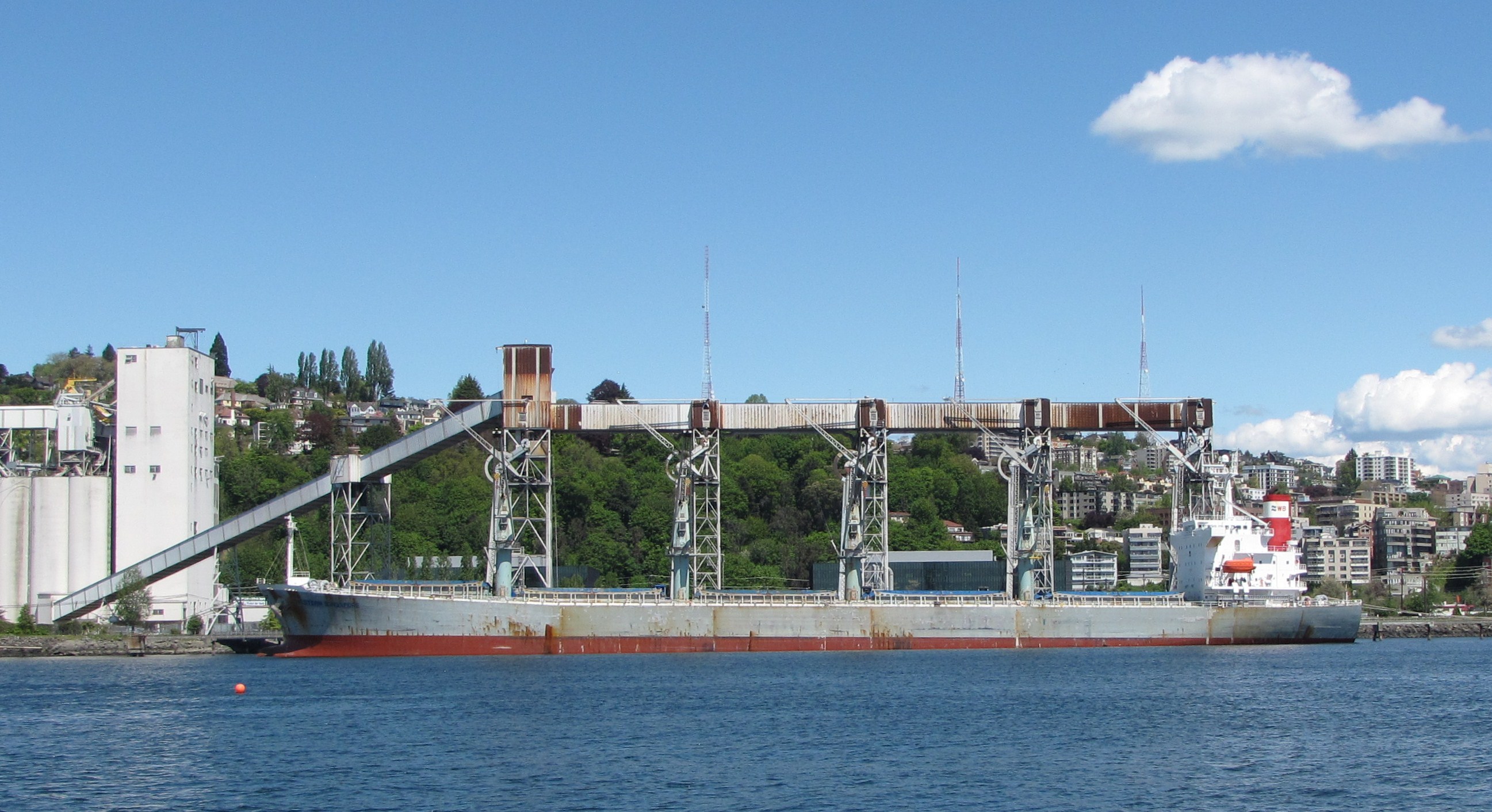
Archive photograph: bulk carrier alongside the Pier 86 grain terminal in Seattle. Photo: Greg Goebel / Wikimedia Commons, CC BY-SA 2.0. Original photograph retained without AI editing; the layout crops its display. The image remains under CC BY-SA 2.0. Illustrative only: not a GT shipment or evidence of a current disruption or any depicted operator's endorsement.