Research reference date: 14 November 2026. Published 20 November 2026. Market observations refer to the periods identified below, not a current quotation or consignment approval.
Key fact: USDA's 12 November review reports a 2.1% quarterly fall in land-route soybean transportation costs alongside a 3.6% rise in landed costs. The comparison concerns its U.S.-Mexico border model, not a current delivered quotation. USDA report, Table 1.
A fresh report on an earlier quarter
USDA's Grain Transportation Report of 12 November reviews second-to-third-quarter 2026 costs. Its Missouri soybean land-route model shows transport declining from USD 53.05 to USD 51.94 per metric tonne, while farm value rises from USD 426.23 to USD 444.60. Combined landed cost increases from USD 479.28 to USD 496.54. USDA report, Table 1, page 4.
These are quarterly observations, not November spot offers. The report's two components should be read together, rather than treating the transport movement as the direction of the complete purchase cost. USDA report.
USDA's glossary defines farm value as an average price received by agricultural producers in a specified state and landed cost as farm value plus transportation. A buyer should therefore distinguish this benchmark from a supplier's complete commercial invoice. USDA glossary.
Commercial interpretation: compare the complete proposal
For feed-ingredient procurement, the useful lesson is to check the goods and logistics components separately before assessing the combined offer. This is GT Nutritions' purchasing interpretation, not a forecast of prices or a recommendation to buy a particular origin.
Ask for a comparison that keeps the product specification, quantity and delivery point consistent. Identify which component has changed and request the basis for that change. If a freight indication improves, check whether the goods offer has been refreshed too. Do not assume that the earlier material price remains available simply because the carrier has issued a newer rate.
Keep quotation dates and validity periods visible. When the goods and transport offers expire at different times, identify what must be reconfirmed before an order can be accepted. Present the combined figure as conditional until those checks are complete, rather than creating a firm-looking total from inputs that cannot be booked together.
Normalize the quantity and currency basis as well. For a container-priced offer, use the agreed net loading quantity when preparing a per-tonne comparison, and retain that assumption beside the calculation. Keep any exchange rate and its date visible. If the expected payload changes, refresh the comparison before describing one proposal as cheaper than another.
Define where the cost calculation stops
The report's land-route estimates stop at U.S.-Mexico border locations. Its rail estimate includes tariff and fuel components but excludes additional shuttle-car service costs. The table also warns that rates may be revised. USDA report, Table 1 notes, page 5.
For an actual enquiry, write the agreed destination beside the total. List which origin handling, inland movement, main carriage and destination services are included. Ask who is quoting each excluded item and whether it remains an estimate. Do not call a port or border calculation a factory-delivered cost without adding and checking the remaining stages.
Where a service provider uses a broad label such as all-in, request the named inclusions and exclusions in writing. Keep that confirmation with the quotation. The objective is a comparison that another buyer can reproduce without needing to infer what a short email description meant.
Use benchmarks to frame questions, not replace quotations
USDA describes the Grain Transportation Report as a weekly publication covering several transport modes. Its separate Mexico Transport Cost Indicator Report is a quarterly series. Publication frequency and the period measured are different attributes; neither makes an older observation a current executable offer. GTR overview, Mexico series overview.
Attach a benchmark's origin, destination, commodity, unit and observation period to any internal comparison. Ask what the evidence actually helps explain. A whole-soybean route model can illustrate cost reconciliation without supplying the price of a processed protein ingredient, a different packaging format or a container movement on another trade lane.
For a co-product enquiry, qualify the source and product first, then request the appropriate transport proposal. Keep a new material specification or loading assumption visible rather than presenting it as an unchanged purchase with a cheaper freight line. Technical approval and commercial comparison should refer to the same proposed goods.
Reconcile planned costs with actual documents
At order approval, retain the accepted calculation and its supporting quotations. As invoices arrive, allocate each charge to the corresponding cost line and shipment. Ask whether an invoice replaces an estimate, adds a new service or duplicates an amount already included elsewhere. Avoid adding the same freight cost through both a supplier invoice and a separate logistics entry.
Before reporting a saving, compare the same cost boundary and quantity basis in the plan and the actual record. Explain differences in goods value and logistics separately, then show their combined effect. An improved freight component is useful information, but the purchasing outcome depends on the reconciled total for the agreed delivery point.
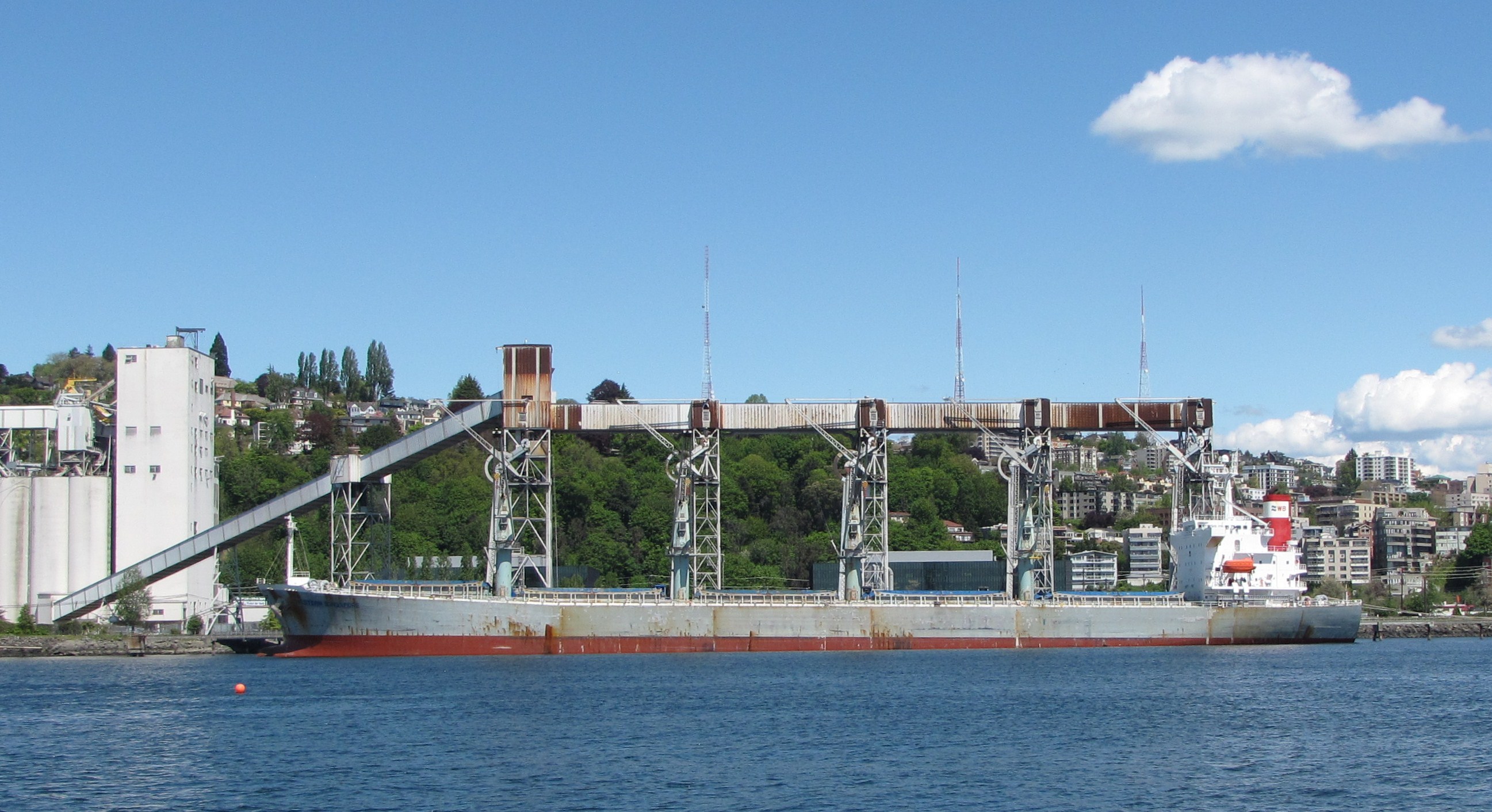
Archive photograph: bulk carrier alongside the Pier 86 grain terminal in Seattle. Photo: Greg Goebel / Wikimedia Commons, CC BY-SA 2.0. Original photograph retained without AI editing; the layout crops its display. The image remains under CC BY-SA 2.0. Illustrative only: not a GT shipment or evidence of a current disruption or any depicted operator's endorsement.