Archived analysis. Original briefing date: 2026-10-03. Archive edition published 20 November 2026. Facts, observations and forecasts relate to their stated dates, not current quotations or shipment approvals.
Key fact: In its 2 October 2026 release, FAO reported that September's vegetable-oil index rose 0.9% month on month, while palm and sunflower quotations moved in opposite directions.
Archive edition prepared 20 November 2026 from the briefing dated 3 October 2026. This analysis preserves the 2 October release vintage, reporting September prices and a then-current cereal-trade forecast. FAO published a newer monthly update on 6 November; these observations are not November prices, current supply conditions or shipment quotations.
What the September release shows
In its 2 October 2026 release, FAO reported that its Vegetable Oil Price Index averaged 198.6 points in September 2026, 18.3% above a year earlier. Higher palm quotations outweighed weaker sunflower prices; soy and rapeseed were broadly stable. The publication reported market observations for September, not an October delivery offer. FAO index, dated 2 October release
Our commercial interpretation is that buyers should reopen the comparison between actual offers rather than adjust every budget by the headline movement. A purchasing decision needs the offered ingredient, approved specification, quantity and delivery period. A broad market signal can justify a fresh enquiry. It cannot supply the missing terms of a contract.
Separate the benchmark from the ingredient
FAO describes its Food Price Index as a monthly measure of international prices for a basket of food commodities, composed of five weighted commodity-group indices. FAO index definition
We therefore recommend treating the vegetable-oil series as context, not as a quotation for salmon oil, a rendered fat or the fat contained in a protein meal. The inference is about the benchmark's scope, not a claim that these markets never influence one another. Do not infer a marine-oil price, fatty-acid profile or available shipment from this release.
Before requesting alternatives, have the formulation team define the function being purchased. Is the requirement an approved energy source, a specified fatty-acid contribution or another agreed characteristic? Record the answer in the enquiry. Consider a substitution only after the responsible technical reviewer approves the material and intended use; a more attractive headline price is not that approval.
Compare offers on one commercial basis
Our suggested buying sheet starts with a common destination, quantity, delivery window, currency and Incoterm. Require each offer to identify its loading point, validity period, packaging and net weight. Keep transport, handling and other charges visible. Where a delivered-cost estimate contains an unconfirmed charge, label it as an estimate rather than presenting it as a binding total.
Separate an available lot from an indicative future supply. Ask which quantity is physically allocated, which depends on production and which remains subject to booking. For recurring volumes, distinguish the first shipment from the proposed monthly programme. That makes an offer easier to assess without assuming that a quotation for one container establishes reliable cover for an entire quarter.
If an indexed pricing proposal is offered, ask the contract reviewer to identify the exact series, observation period, currency treatment, adjustment formula and revision policy. Do not accept a reference simply called the oil index. The proposal should also explain which costs remain fixed or separate. This is our contract-management recommendation, not a statement that FAO requires any particular pricing formula.
Keep specifications ahead of substitution
The European Commission identifies Regulation 767/2009 as the framework for marketing feed materials and compound feed and provides links to the feed-material catalogue and classification guidance. Those are existing regulatory reference points, not changes announced in the October market release. Commission feed marketing overview
Our recommended technical comparison should retain product identity, origin, processing description and the agreed analytical limits. For an oil enquiry, ask the reviewer which quality measures, fatty-acid information, antioxidant declaration and storage conditions are relevant to the intended application. Request the corresponding specification and lot Certificate of Analysis. Do not copy one ingredient's limits into another enquiry without review.
For a protein meal with a fat specification, keep protein, ash, moisture and digestibility requirements in the same assessment. Do not rank it as if it were a standalone oil. Any calculated nutritional value should use a consistent, approved method and declared analytical basis. Where that assessment is incomplete, keep the commercial comparison provisional rather than filling the gap with an assumed equivalence.
Check the delivery plan separately
FAO's accompanying 2 October 2026 cereal brief reduced its world cereal-trade forecast by 3.5 million tonnes from September, mainly reflecting constrained Black Sea shipping and insufficient alternative transport capacity. This is a cereal-market finding, not proof that a particular oil shipment is delayed. FAO Cereal Supply and Demand Brief
For procurement, we recommend checking each proposed route directly. Ask for a realistic loading window, the transport arrangement and the party responsible for confirming the booking. Keep arrival estimates separate from guaranteed commitments. Where the route is unresolved, agree how a delay would affect delivery, documentary deadlines and release of any advance payment before committing funds.
Turn the release into a controlled buying review
For the October 2026 buying review, the recommendation was to classify each open requirement as technically approved, commercially comparable and logistically confirmed. Record the unresolved question and its owner beside every offer. A revised offer should replace its predecessor without deleting the history needed to explain the decision.
The opportunity is a more disciplined comparison, not a forecast of cheaper or more expensive feed. September's divergence supports asking more precise questions. The final purchase should still depend on the approved ingredient, evidenced quality, workable delivery and agreed terms.
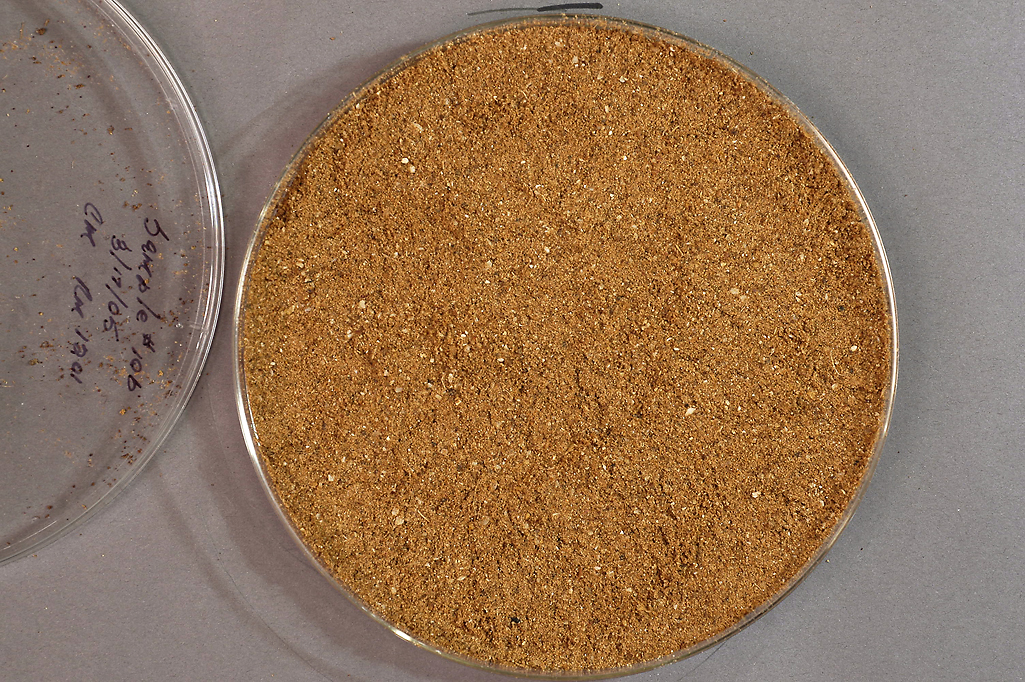
Archive photograph of meat-and-bone meal. Source: USDA Agricultural Research Service via Wikimedia Commons (public domain). Original photograph retained without AI editing; the layout crops its display. For illustration only: not a GT product or certified lot. Species, material category and regulatory eligibility are not established by this photograph.